
Not legal advice. OSTA is educational advocacy, not a law firm. This page is general information for Oregon manufactured dwelling park and marina tenancies — you own the home and rent the space (ORS 90.505–90.850). It does not apply to apartment or other standard ORS 90.100–90.465 rentals. It is not legal advice. Talk with an attorney about your situation.
Oregon statutory protections
ORS 90.765 · Park and marina space tenancies
Landlord retaliation: know your rights and protect your home
If you own the home and rent the space in an Oregon manufactured dwelling park or marina, the landlord may not punish you for standing up for your rights or organizing with neighbors. Facility-space retaliation is prohibited by ORS 90.765 (in addition to the general rule in ORS 90.385). This page does not apply to apartment rentals.
If the landlord violates that facility rule, you may recover actual damages or $500, whichever is greater (ORS 90.710(1)), and you have a defense in a retaliatory possession case. That is not apartment ORS 90.375 two-months’-rent damages. This is educational, not legal advice.
Statutory rights
Protected activities under Oregon law
A facility landlord may not retaliate after you do any of the following (ORS 90.765(1)). The general rule in ORS 90.385 still applies; ORS 90.765 is written for space tenancies.
Good-faith complaints to the landlord
Any complaint to the landlord that is in good faith — including space rent, maintenance, rules, or facility hazards (ORS 90.765(1)(b)).
Complaints to agencies
Expressing an intention to complain to agencies listed in ORS 90.385 — building, health, or housing code; mail delivery; or rental-housing discrimination — or actually complaining (ORS 90.765(1)(a)).
Organizing and associations
Assembling, canvassing, and distributing association literature are protected in the facility (ORS 90.750). See Resident Associations. Joining or forming a tenants’ organization is also listed in ORS 90.385(1)(c).
Asserting other legal rights
Performing — or saying you will perform — any other act to assert tenant rights under federal, state, or local law (ORS 90.765(1)(c)–(d)), including a BOLI complaint under ORS 659A.820 or requesting mandatory mediation. See Mandatory Mediation.
Unlawful management pushback
What counts as illegal retaliation?
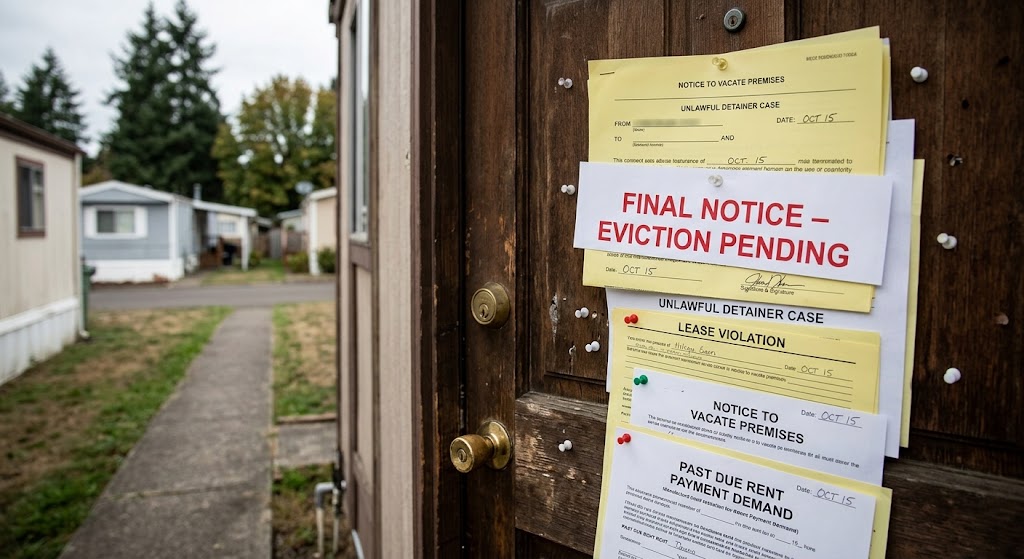
The statute names four landlord moves: increasing rent, decreasing services, serving a notice to terminate the tenancy, or bringing or threatening an action for possession after a protected act (ORS 90.765(1)). Timing plus a protected act is evidence — Oregon’s current text does not create an automatic legal presumption. A court still decides the facts.
Rent increases
Raising space rent after a protected complaint or organizing. Facility space rent still follows ORS 90.600 and the yearly DAS cap — not apartment ORS 90.323. A lawful 90.600 increase is not automatically retaliation; a spike right after you complained can be (ORS 90.765).
Decreasing services
Cutting or restricting services after a protected act (ORS 90.765). ORS 90.385(2) also treats unreasonably restricting tenant-association use of common areas, and intentionally interfering with enjoyment of the premises, as decreasing services.
Termination notices and possession cases
Serving a termination notice or filing (or threatening) an action for possession after a protected act (ORS 90.765). Facility space nonpayment and cause are generally ORS 90.630 — not apartment 72/144-hour ORS 90.394 practice.
Harassment, access, and immigration threats
A landlord may not abuse the right of access or use it to harass you (ORS 90.725(4)). Disclosing or threatening to disclose immigration or citizenship status to harass, retaliate, or intimidate is separately prohibited (ORS 90.388).
Practical next steps
What to do if you experience retaliation
Write things down, keep copies, and get advice early. If you have court papers, talk with a lawyer or legal aid the same day. OSTA is educational advocacy, not a law firm.
1
Document everything
Keep dated copies of letters, emails, photos, rule-violation warnings, rent notices, and names of neighbors who saw what happened. Prefer writing over hallway conversations.
2
Put the claim in writing
Send a dated letter or email that describes what you did (the protected act), what the landlord did next, and that you are asserting ORS 90.765. Keep a copy. Cite ORS 90.710(1) if you are asking for the statutory remedy.
3
Ask about mandatory mediation
If the dispute is eligible under ORS 90.767, either side can start mediation. Related court filings — including possession — generally cannot be filed while mediation is ongoing. Call MMCRC at 1-800-453-5511, or read Mandatory Mediation and how OHCS describes the process.
4
Get legal help if court is involved
If you are served with a FED / eviction complaint or a termination notice, contact Oregon Law Help / Eviction Defense Project, Legal Aid Services of Oregon, or the Oregon State Bar lawyer referral immediately.
Collective protection
Strength in numbers: a tenant association
Facility rules may not block peaceable assembly, neighbor-to-neighbor communication, or canvassing for a tenants’ association at reasonable times (ORS 90.750). You may also invite speakers on public issues, subject to reasonable time-and-place rules (ORS 90.755). The landlord is not required to let anyone solicit money, except association dues collection as the statute allows.
If a facility rule or rental-agreement clause is used to stop those rights, Oregon law also allows a court action to enjoin that provision. Talk with an attorney about that path.
Resident advocacy
Have Questions?
OSTA is a 501(c)(3) educational advocacy nonprofit for manufactured dwelling park and marina households. We can help you document what happened and find the next step. We are not a law firm and we do not appear in court.