
Statutory rights and dispute resolution

ORS 90.767 · Park and marina space tenancies

Mandatory mediation for Oregon manufactured and floating home communities

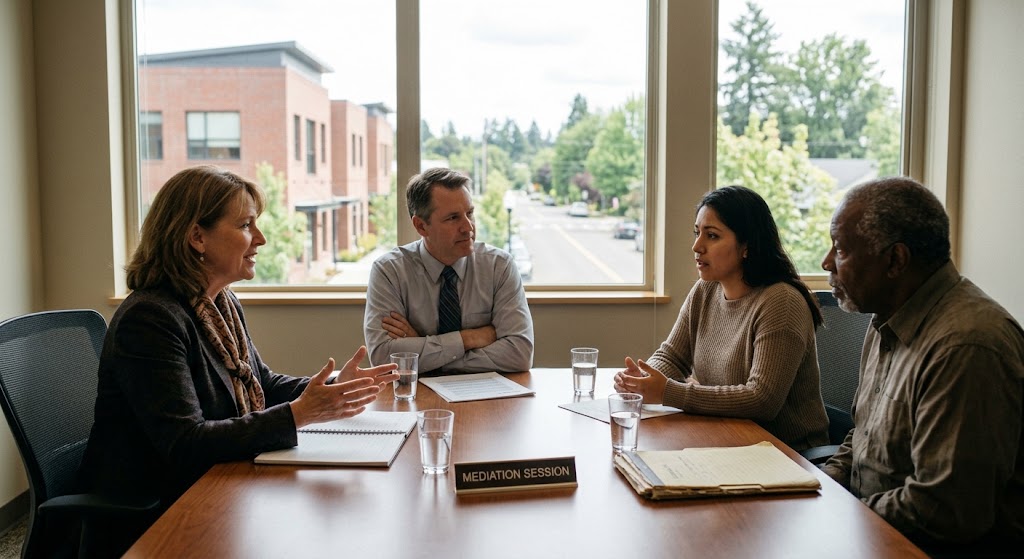
If you own the home and rent the space in an Oregon manufactured dwelling park or marina, the landlord must keep a mandatory mediation policy (ORS 90.767). Either the landlord or a tenant can start mediation for eligible disputes. Once it is initiated, participation is required, and related court filings — including an action for possession — cannot be filed while mediation is ongoing.

This page does not apply to apartment rentals. A trained mediator is a neutral third party. They do not decide the case for you.
Oregon marina community

Statutory protections

Key benefits and protections

The statute equalizes access to a no-cost process and pauses related court action after mediation starts — if the dispute is eligible.

No session bill from the mediator

OHCS and participating community dispute resolution centers offer this mediation at no cost to the parties (how mediation works). Oregon funds MMCRC work in part with a $10 annual special assessment on manufactured dwellings and floating homes assessed as personal property (ORS 456.418). You are not billed for session time.

Publicly funded service

Related court filings pause

After mediation is initiated and while it is ongoing, a party may not file an action related to the dispute, including an action for possession (ORS 90.767(5)). Statutes of limitations are also tolled. You must keep paying rent. Rent the landlord receives during mediation is not “accepted rent” under ORS 90.412(2) if the landlord refunds it within 10 days after mediation ends.

Stay while mediation is open

Confidential communications

Communications in this mediation must be held strictly confidential and may not be used in legal proceedings (ORS 90.767(3)(c)). ORS 90.771 separately requires OHCS to keep identities and dispute information confidential, with limited exceptions.

ORS 90.767 and 90.771

You do not waive legal rights

You must make a good-faith effort to schedule, attend, and participate. You are not required to reach an agreement, sit through more than one session, stay for an unreasonable time, or waive other remedies (ORS 90.767(4), (7)).

You may bring a representative

A party may designate any person, including a non-attorney, to represent them if that person has authority to bind the party to a resolution (ORS 90.767(3)(e)). Confirm the park representative has written authority to sign.

Statutory scope

Eligible disputes vs. exempt issues

Whether the dispute is eligible determines whether related court action must wait. Parties may still agree in writing to mediate something that is otherwise exempt, or the landlord’s written mediation policy may allow it.

What is eligible

Mandatory if someone initiates

  • Landlord or tenant compliance with the rental agreement or Chapter 90 (ORS 90.767(1)(a)).
  • Landlord or tenant conduct within the facility.
  • Proposed rule or regulation changes under ORS 90.610. See Park Rule Changes.
  • Landlord vs. tenant disputes, started by either side; tenant vs. tenant disputes, started only by the landlord (ORS 90.767(3)(d)).

What is exempt unless everyone agrees

Not forced into this process

  • Facility space rent increases (ORS 90.600 / ORS 90.324) — not apartment ORS 90.323.
  • Rent payments or amounts owed (ORS 90.767(6)(d)).
  • Tenant violations alleged in a termination notice under ORS 90.394, ORS 90.396, or ORS 90.630(10). Facility space nonpayment is generally 90.630 — not apartment 72/144-hour ORS 90.394 practice.
  • Facility closures (ORS 90.645 / 90.671) and facility sales (ORS 90.842–90.850).
  • Unauthorized person in possession notices (ORS 90.403).
  • Domestic violence, sexual assault, bias crime, or stalking — unless the victim initiates — and disputes between victim and alleged perpetrator.
  • Disputes after the tenancy has ended.

Step-by-step

How the process works

Start with your local community dispute resolution center or the MMCRC hotline. Facilities may also offer informal dispute resolution in addition to mandatory mediation (ORS 90.769).

1

Eligible dispute

A rental-agreement, Chapter 90, conduct, or 90.610 rule-change issue arises.

2

Contact MMCRC or a CDRC

Call 1-800-453-5511, email [email protected], or use the local CDRC. Either landlord or tenant may start.

3

Court filings pause

Once initiated, related actions — including possession — may not be filed while mediation is ongoing. Keep paying rent.

4

Schedule in good faith

Parties must make a good-faith effort to schedule within 30 days after mediation is initiated, attend, and cooperate with the mediator.

If you participate

Agreement: put it in writing so both sides are bound. No agreement: the process ends and either side may use other legal remedies. The mediator tells OHCS only whether it resolved — not the contents.

If someone refuses

Refusal to participate in good faith, or using mediation to harass, gives the other party a defense to a related claim and damages of one month’s rent (ORS 90.767(10)).

Statutory enforcement

Good faith and penalties

Good faith means a real effort to schedule within 30 days, show up, participate, and cooperate with reasonable mediator requests (ORS 90.767(4), (10)). Harassment or a no-show can trigger the one-month rent damages and the related-claim defense.

Practical preparation

Tips for preparing

Bring documents

Rental agreement, park rules, notices, receipts, emails, dated photos, and the Chapter 90 sections that apply. Open statutes on this site with Read the statute.

Confirm authority

If management sends a manager, ask at the start whether they have written authority to negotiate and sign a binding agreement.

Bring support

You may designate a representative — attorney, advocate, translator, or trusted person — if they can bind you to a deal.

Retaliation is unlawful

A landlord may not retaliate for asserting rights under state law, including requesting mediation (ORS 90.765). Remedies include ORS 90.710(1) ($500 or actual damages). Document what happened and tell MMCRC.

Have Questions?

Start with MMCRC or your local CDRC for the statutory process. OSTA can help you understand the next step. We are educational advocacy, not a law firm.

MMCRC hotline

1-800-453-5511

Oregon Housing and Community Services · manufactured and marina communities

Eviction Defense Project (EDP) · Legal Aid Services of Oregon (LASO) · Oregon State Bar lawyer referral

Tenant defense support

Have Questions?

If you received a termination notice, a rule-change packet, or a mediation letter, our resident-led network can help you sort eligible vs. exempt issues before you call MMCRC.

ORS Chapter 90

A cited section opens here.