
Not legal advice. OSTA is educational advocacy, not a law firm. This page is general information for Oregon manufactured dwelling park and marina tenancies — you own the home and rent the space (ORS 90.505–90.850). It does not apply to apartment or other standard ORS 90.100–90.465 rentals. It is not legal advice. Talk with an attorney about your situation.
Civic participation in Salem
Oregon Legislative Assembly · park and marina residents
Legislative advocacy: your voice shapes Oregon law
If you own the home and rent the space in an Oregon manufactured dwelling park or marina, the statutes that protect that tenancy were written in Salem. Legislators hear from lobbyists every day. They also hear from residents who show up, write, and testify.
This page is a how-to for civic participation — not a list of current bills, and not legal advice. It does not apply to apartment rentals. Committee windows and hearing rules come from the Legislative Assembly’s published citizen-engagement instructions and can change; always confirm on OLIS for the hearing you care about.
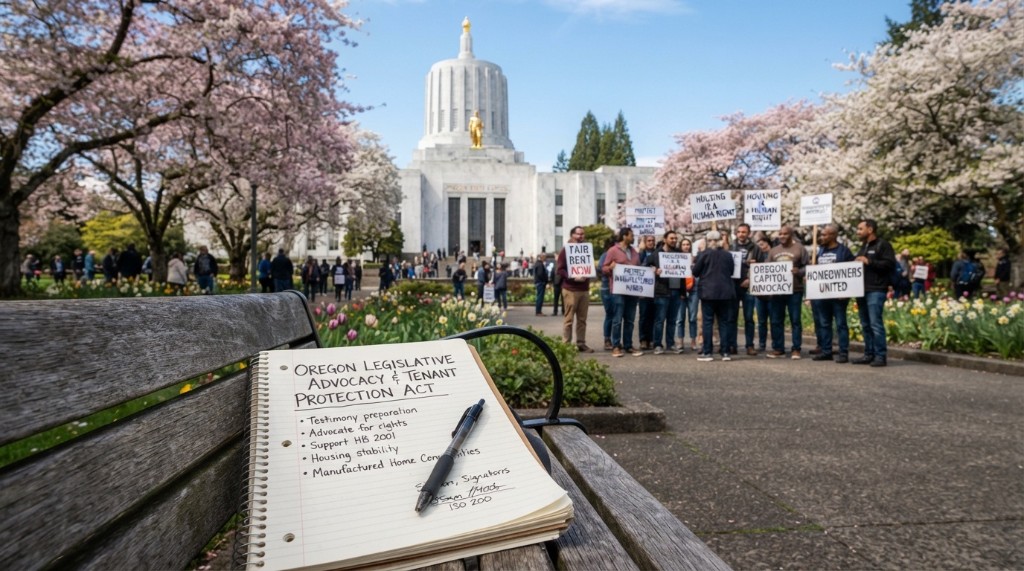
Replace this photo in the editor with a Capitol or community image.
Oregon legislative process
How an idea becomes a bill in Oregon
Bills can start in either chamber. Both the House and Senate must pass identical text before a measure goes to the Governor. Many bills never leave committee. The Legislative Assembly’s own overview is How an Idea Becomes Law.
1
The idea
A resident, OSTA, another coalition, or a legislator names a problem and a policy change — for example a Chapter 90 facility-tenancy rule.
2
Bill drafting
Nonpartisan Legislative Counsel turns the concept into bill language that would amend Oregon law.
3
Introduction and bill number
The measure is introduced as a House Bill (HB) or Senate Bill (SB) and is usually referred to a subject committee.
4
Readings and the docket
The measure is read into the chamber record and appears on OLIS so the public can track it.
5 · Critical stage for public testimony
Committee work and public hearings
Committees schedule public hearings. This is when park and marina residents can submit written testimony or register to speak. A committee can amend a bill, send it forward, or let it die. Work sessions are usually for member debate and votes — not a second open-mic, unless the agenda says otherwise.
6
Floor debate and vote
If the committee reports the bill out, the full chamber debates and votes. Passage still requires the other chamber to agree to the same text.
7
Second chamber
The other chamber repeats committee and floor steps. If the text changes, the houses must reconcile until both pass identical language.
8
The Governor’s desk
The Governor may sign the enrolled bill, let it become law without a signature, or veto it. A veto can be overridden by a two-thirds vote in each house. Unless the Act sets a different date, an Act takes effect on January 1 of the year after passage (ORS 171.022). Signed acts are filed with the Secretary of State and then folded into the Oregon Revised Statutes.
Citizen participation
How to submit testimony on a bill
Oregon publishes two tracks: written testimony, and live testimony (Capitol, Microsoft Teams, or phone). Both are explained on Submit Exhibits / testimony and OLIS Help: Testimony. Confirm the agenda on OLIS for the hearing you mean to join.
Written testimony on OLIS
Open when a hearing is posted
Where to submit
Open olis.oregonlegislature.gov. On the bill page, use Submit Testimony. For a topic or appointment, use the committee staff “Click to Submit Testimony” link. You can type in the form or upload a PDF.
OLIS window
The Legislative Assembly’s published rule: written testimony may be submitted from the time a public hearing is scheduled until 48 hours after that committee meeting’s start time. After the window closes, you can still email committee members or your own legislators — that is not the OLIS exhibit packet.
Public record
Written testimony is posted on OLIS and is searchable. The Legislature says email addresses on the submission form are not posted. Do not put a street address, phone number, Social Security number, or health history in the document if you do not want that information public.
Written testimony still becomes part of the committee record.
Live testimony (in person, Teams, or phone)
Advance registration required
Registration window
Online registration opens when the public hearing is scheduled and closes 30 minutes before the meeting begins. You cannot register after that cutoff.
How to register
On the OLIS bill page choose Register to Testify, or call toll-free 1-833-588-4500 for staff help. You will get a confirmation email with Teams or phone join details — do not share your Teams link.
How you can appear
In person at the State Capitol in Salem, remotely on Microsoft Teams, or by phone. Ask committee staff 24 hours ahead if you need an accommodation. Interpreter or translation requests: [email protected] or 503-986-1813, at least three business days before the hearing.
What to say in a short slot
Committees often limit each speaker to a few minutes (commonly two or three — check the chair’s instructions that day). State your name, city, park or marina community, and whether you support, oppose, or are neutral. One concrete story about how the bill would affect your space tenancy is more useful than a speech.
Practice out loud with a timer before the hearing.
Direct communication
Writing to your legislators
A short message from someone who lives in the district still matters. Identify yourself as a manufactured dwelling park or marina space tenant so staff can file you as a constituent with a facility-tenancy stake — not an apartment renter.
Before committee hearings
Write the chair and committee members while the bill is being heard, amended, or at risk of dying in committee.
Before a floor vote
Write your own Representative or Senator in the 24–48 hours before a chamber vote on a bill that already left committee.
During the interim
Go to town halls and coffees, or invite your legislator to walk your park or marina so they see space-rent and rule issues on the ground.
How to structure your message
| Part | What to do | Example |
|---|---|---|
| Subject | Bill number and your position. | Vote YES on HB 1234 — protect manufactured-home space tenants |
| Opening | Name, city, district, and that you own the home and rent the space. | I live in Eugene in House District 13, in a manufactured dwelling park. |
| The ask | One clear action: support, oppose, or amend. | Please support HB 1234 when it comes to the House floor. |
| Your story | Two or three sentences on rent, rules, or displacement — not apartment 90.323 examples. | On a fixed income, a space-rent increase under ORS 90.600 can decide whether I keep this home. |
| Close | Thank them and ask how they plan to vote. | Thank you. Please tell me how you plan to vote. |
Essential Oregon legislature resources
Official portals and phones. OSTA can help you prepare; we do not control committee calendars.
Find your legislator
Official district lookup — enter your full address.
Capitol address
900 Court St NE, Salem, OR 97301
Public hearings are in committee rooms. Confirm building access on the legislature site before you travel.
Information desk
Capitol information desk. During session from outside Salem, the Oregon Blue Book also lists 1-800-332-2313.
Testimony help (toll-free)
Legislative staff can help you register to testify if you cannot use OLIS.
Resident coalition
Join the OSTA advocacy network
OSTA is a 501(c)(3) educational advocacy nonprofit for manufactured dwelling park and marina households. We help residents track facility-tenancy bills and prepare testimony. We are not a law firm and we do not run the committee calendar.