
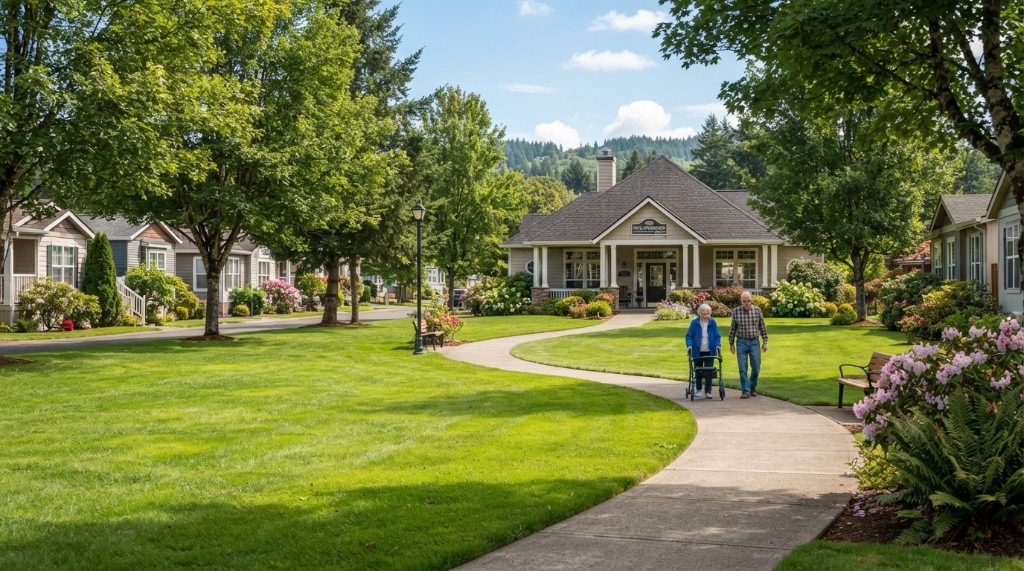
ORS Chapter 90.842 & 90.844 statutory framework
Resident-Owned Communities (ROC): How Oregon Tenants Buy Their Park
When a park owner decides to sell, Oregon law provides manufactured home residents the legal right to organize, compete to purchase, and transition their neighborhood into a permanently affordable Resident-Owned Community.
Last updated: 2026 Session · HB 2446 preserving communities · State capital gains exemption verified
Not legal advice. OSTA is educational advocacy, not a law firm. This page is general information for Oregon manufactured dwelling park and marina tenancies — you own the home and rent the space (ORS 90.505–90.850). It does not apply to apartment or other standard ORS 90.100–90.465 rentals. It is not legal advice. Talk with an attorney about your situation.
Statutory notice & legal disclaimer
Disclaimer: OSTA provides education and organizational technical referrals. Purchasing a community involves corporate real estate acquisition and financing. Consult legal counsel and qualified technical assistance providers before executing purchase agreements.
Structured pathway
The 6-step ROC acquisition roadmap
Transforming an investor-owned park into a resident-owned cooperative requires collective solidarity and structured execution.
Step 1
Organize the community
Residents come together, build consensus, and commit to working as a team to secure their housing future.
Key milestone: Formation of an active, representative tenant committee.
Step 2
Receive sale notice
Homeowners obtain formal notice that the manufactured home park is being put up for sale under ORS 90.842.
Key milestone: Triggers strict statutory 15-day timeline clocks.
Step 3
Partner with support
Partner with technical assistance organizations like CASA of Oregon and ROC USA for legal, financial, and organizational guidance.
Key milestone: Execution of a professional technical assistance agreement.
Step 4
Secure financing
Work with specialized lenders and partner organizations to obtain the funding needed to purchase the property.
Key milestone: Loan pre-approval via Community Development Financial Institutions (CDFI).
Step 5
Complete acquisition
Finalize the purchase process (typically 9+ months) to officially transition into a Resident-Owned Community (ROC).
Key milestone: Closing escrow, deed transfer, and debt structuring.
Step 6
Assume ownership
Take direct control of park rules, management decisions, infrastructure repairs, and rent stabilization as resident-owners.
Ultimate outcome: Self-governed democratic community with stable rents.
Strict legal benchmarks
Statutory timelines & procedures (ORS 90.842 & ORS 90.844)
Oregon laws establish rapid statutory windows. Missing an early deadline terminates tenant purchase rights. Review these timelines carefully. (ORS Chapter 90)
Day 0 — Notice of intent to sell
Requirement: Before publicly marketing the park or considering a purchase offer, the owner must deliver written notice to all tenants (or an existing tenants committee) and the Oregon Housing and Community Services (OHCS) department.
Validity: Notice remains valid for 1 calendar year from the date delivered.
Days 1–15 — Expression of interest & financial request (critical)
15-day deadline: Tenants must form or identify a single tenants committee, send written notification to the owner expressing interest in competing to purchase, and designate a primary representative.
Financial request: Within this same 15-day window, the representative requests key financial records (asking price, income, operating expenses, utility costs) for preliminary due diligence.
Action required immediately: Contact the OSTA helpline within 48 hours of receiving notice to mobilize technical organizers.
Click to Call Now CASA of Oregon: (503) 537-0319+14 days — Owner financial disclosure
The park owner must deliver the requested financial records to the tenants committee representative within 14 days of receipt.
45 days — Offer submission & entity formation
Forty-five days from delivery of financial records (or the end of the initial 15-day window if none were requested) to form a cooperative entity (ORS Chapter 62) or associate with a qualified nonprofit (CASA of Oregon / ROC USA affiliate), and deliver a formal written Purchase and Sale Agreement (PSA).
Final — Negotiation & purchase agreement
The owner may accept, reject, or submit a counteroffer. If accepted, custom closing timelines, due diligence, and inspection windows govern the sale.
Landlord value proposition
Landlord win-win incentives: tax & financial advantages
Why selling to residents can create stronger financial, operational, and community outcomes for park owners than traditional commercial liquidations.
100% state capital gains tax exemption
Exemption from Oregon personal income tax (ORS 316) and corporate excise tax (ORS 317) when selling directly to an eligible tenant cooperative, 501(c)(3) nonprofit (CASA of Oregon), or local housing authority.
Avoidance of relocation payouts (ORS 90.645)
If closed or converted, a landlord may owe substantial per-space relocation assistance. Selling to residents preserves the park and can eliminate this liability.
Federal 1031 exchange compatibility
A landlord may combine the Oregon capital gains exemption with a federal Section 1031 like-kind exchange to defer federal taxes.
Smoother transaction & vetted funding
CASA of Oregon and ROC USA bring experienced underwriting, technical assistance, and proven nonprofit capital lenders, reducing deal fallout risk.
Certified technical guidance
Accredited technical assistance partners
Do not navigate the purchase process alone. Connect directly with authorized state and national certified nonprofit intermediaries.
Oregon state lead partner
CASA of Oregon
Role: Oregon’s premier manufactured housing cooperative technical assistance provider.
20508 SW Roy Rogers Rd, Suite 155, Sherwood, OR 97140
National network affiliate
ROC USA (Resident-Owned Communities)
Role: National nonprofit social venture supporting resident ownership.
Concord, NH / Washington, D.C.