
Not legal advice. OSTA is educational advocacy, not a law firm. This page is general information for Oregon manufactured dwelling park and marina tenancies — you own the home and rent the space (ORS 90.505–90.850). It does not apply to apartment or other standard ORS 90.100–90.465 rentals. It is not legal advice. Talk with an attorney about your situation.
ORS 90.505–90.850 · Marina space tenancies
Marina & floating-home tenancies in Oregon
If you own a floating home and rent the space under it in an Oregon marina, special landlord–tenant rules apply. Those rules sit in ORS Chapter 90 — the same chapter that covers manufactured dwelling parks — and they are stronger than ordinary boat-slip arrangements.
This page is only for people who own the floating home and rent the moorage space in a statutory marina facility. It does not apply to apartment rentals. It explains who the facility package covers, documents and rent rules, how tenancies can end, sale-in-place, and marina closure. Educational only — not legal advice. Last checked against official ORS Chapter 90 and 2026 DAS rent-cap figures (September 2026).
Who is covered
Who these rules cover (and who they don’t)
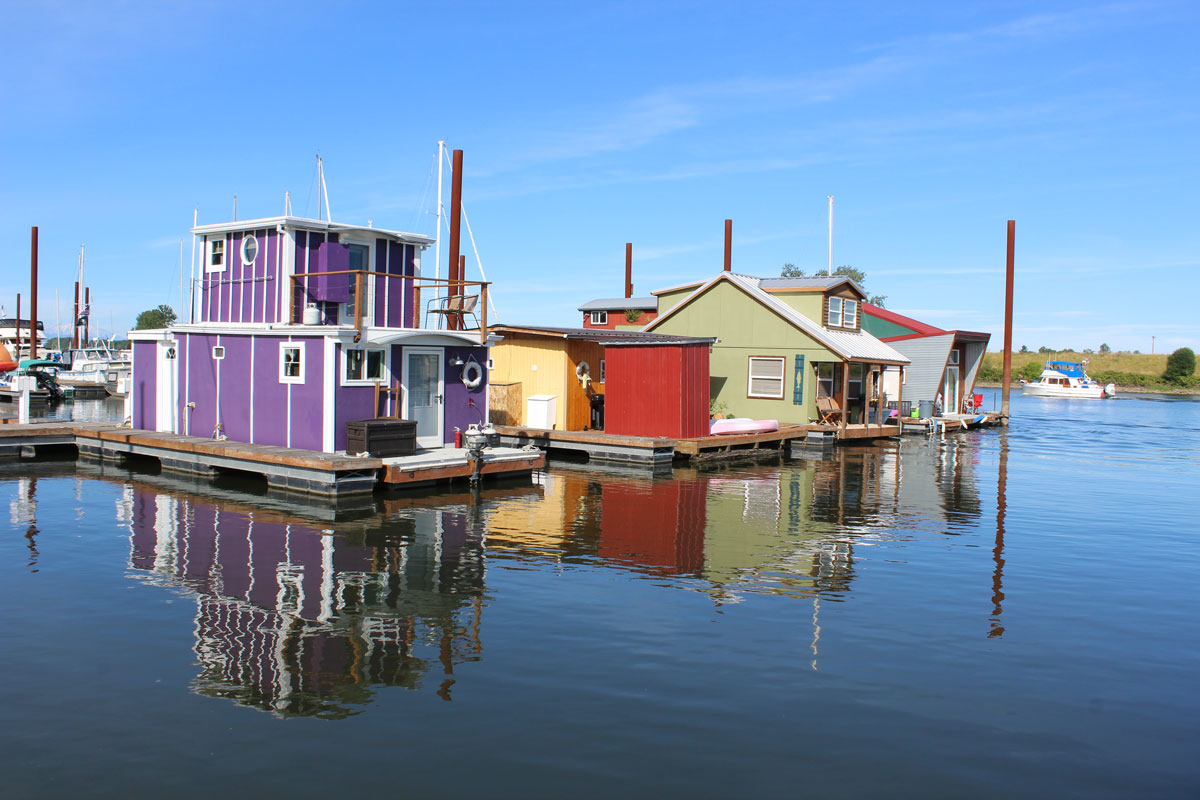
Oregon’s strongest marina protections apply when all of the following are true (ORS 90.120(3)): you own the floating home; you rent the space (moorage); and that space is in a facility. A “facility” is a manufactured dwelling park or a marina (ORS 90.100(16)). A marina is a moorage of contiguous dwelling units that may be transferred as a single unit, owned by one person, where four or more floating homes are secured, and the primary purpose is to rent space (ORS 90.100(30)).
A floating home has the meaning in ORS 90.100(20), which points to ORS 830.700: a moored structure secured to a pier or pilings and used primarily as a domicile, not as a boat. Occasional use for transport does not automatically take you out of that definition if the structure is still primarily your home (see Ramsum v. Woldridge, 222 Or App 109, 192 P3d 851 (2008)).
If you meet this test, the manufactured dwelling park and marina package in ORS 90.505–90.850 generally applies, along with other Chapter 90 provisions that cover facilities.
Recreational boat slips
Renting a recreational boat slip is not the same as a floating-home marina tenancy
Many boaters assume they have the same rights as floating-home owners in a statutory marina. Often they do not. Recreational vehicles are excluded from the facility package, and a vessel that is not primarily a domicile floating home — or moorage that is not a marina with four or more floating homes — may not be covered by ORS 90.120(3). Confirm your classification before you rely on marina-tenant rules.
Arrangements this page does not cover
You rent both the home and the space
That arrangement is classified under general Chapter 90 rules, not the full marina facility package (ORS 90.120(5)(b)). OSTA public guidance on this site is for space tenancies only. Talk with the helpline or an attorney.
You own the home but the space is not in a facility
If the space is outside a statutory marina or park, the ORS 90.505–90.850 package does not apply (ORS 90.120(5)(c)). Different notice rules may apply. This hub does not give advice for those tenancies — start with classification help from OSTA or a lawyer.
Documents
Your rental agreement, statement of policy, and marina rules
Facility landlords must provide key written documents (ORS 90.510), including a written statement of policy (separate from the rental agreement), a written rental agreement, and enforceable rules. The statement of policy typically covers rent history for the space, utilities, and screening conditions that apply if you later sell to a buyer who needs landlord approval.
- Space rental term: month-to-month or a fixed term of at least two years (ORS 90.550).
- Suits for intentional failure to give the policy packet (statement of policy and attached agreement/rules) must be started within one year after discovery or identification of the alleged violation (ORS 90.510(10)).
- Marina rules are part of the deal. Material violations can lead to termination after proper notice and, in many cases, a chance to cure (ORS 90.630).
Tip: Keep copies of everything you sign and everything the landlord gives you at move-in or sale.
2026 DAS figures
Rent increases (notice + 2026 caps)
For month-to-month facility tenancies (ORS 90.600): the landlord must give 90 days’ written notice; rent may be increased only once every 12 months; and the increase is capped by the annual maximum under ORS 90.324 (DAS publishes the calculation). These caps apply to park and marina space rent — not apartment ORS 90.323 tenancies. Violating the percentage cap can create landlord liability of three months’ rent plus actual damages. Tenants may elect a committee of seven or fewer to meet the landlord on non-rent issues.
- 2026 · More than 30 spaces: 6% maximum annual increase (formula set by HB 3054 (2025)).
- 2026 · 30 or fewer spaces: 9.5% maximum (the lesser of 10% or 7% + CPI).
Caps limit how much rent can go up — they do not freeze rent. A separate infrastructure-increase path can apply in some larger facilities after a tenant vote (ORS 90.600(3)). See Rent and Utilities for the full facility rent guide. Confirm DAS each September.
Notices
Ending a tenancy / eviction basics
Common landlord-for-cause paths include material rule or law violations, certain fees or utility charges, and related grounds — generally 30 days’ notice with cure rights in many cases (ORS 90.630). Exceptions include certain repeat violations within six months, a level-three sex-offender classification (no cure), and repeated late-rent processes after multiple nonpayment notices. Physical condition of the floating home is a separate track (ORS 90.632) — typically 60 days to correct (30 if there is a risk of imminent serious harm), and float-related repair time can be extended by up to 10 additional months. Nonpayment of space rent may still proceed under ORS 90.394. Marina closure rules do not block those cause terminations.
Tenants who rent space for a floating home may terminate a month-to-month or fixed-term agreement without cause by giving at least 30 days’ written notice (ORS 90.620). A tenant may not be required to give more than 30 days’ notice.
Facility tenants have limits on retaliation (ORS 90.765); statutory damages for a 90.765 violation are actual damages or $500, whichever is greater (ORS 90.710(1)) — not apartment two-months’-rent damages. Many facility disputes have a mandatory mediation path (ORS 90.767; see Mandatory Mediation). You also have rights to assemble, canvass, and speak on political issues (ORS 90.750, 90.755; see Resident Associations).
Eviction from the slip can force a costly float move or a fire-sale of a home that is hard to relocate. Get advice early — do not wait until a notice deadline is hours away.
Sale in place
Selling your floating home in the marina
Under ORS 90.680, a facility landlord generally may not deny your right to sell the home on the rented space, may not require removal solely because of the sale, may require the buyer to apply and be approved as a tenant, must accept or reject a complete buyer application in a short window (generally 7 days, or 10 if the seller did not give the 10-day sale notice), may not unreasonably reject an applicant, and must use screening similar to the landlord’s own sales practices. For-sale signs are allowed subject to reasonable rules. Different rules apply if the marina sells the home on consignment. A landlord may not require an interior inspection as a condition of the sale or the new tenancy (ORS 90.680(15)). See Selling Your Home.
Abandoned or post-termination homes are handled under ORS 90.675 (storage, claim periods, disposition). ORS 90.634 prohibits a landlord lien for space rent against the floating home in a facility — that is not the same as “they’ll just seize your boat.” It does not replace other remedies landlords may pursue.
ORS 90.671
If the marina closes
ORS 90.671 covers voluntary conversion or closure of a marina (or a portion with spaces). That is a different statute from park closure (Park Closure and Relocation). The landlord may give 365 days’ written notice, or 180 days’ notice if the landlord finds space acceptable to the tenant and pays moving and set-up costs or $3,500, whichever is less.
- No rent increase to offset those payments, and no rent increase after the closure notice.
- Temporary relocation within the same marina, or a same-owner marina in the same city, is allowed for repairs or remodel.
- If closure is by eminent domain or agency order, the landlord must notify tenants within 15 days of receiving that notice and describe any known government relocation benefits.
Reality check: long notice helps, but a 180-day path with a $3,500 moving/set-up cap may not cover the true cost of moving a floating home.
Facility sale and tenant purchase-opportunity procedures appear in ORS 90.842–90.850. A marina purchase association is a group of three or more marina tenants organized to eventually purchase the marina (ORS 90.100(31)).
Practical list
Common challenges for marina residents
- Classification — Floating home? Statutory marina (4+ homes)? Your rights swing on those answers.
- You own the home, not the water or land — losing the slip can mean an expensive move or a distressed sale.
- Rent pressure — increases are capped, but still significant on fixed incomes; 90-day notice is short for a float move.
- Buyer approval — sale-in-place depends on landlord acceptance of the buyer (ORS 90.680).
- Rules enforcement — material rule violations can end a tenancy after notice and cure (ORS 90.510, 90.630).
- Home condition — disrepair can trigger the ORS 90.632 termination path, including extra time for float repairs.
- Closure / redevelopment — notice periods help; relocation money may not match real costs (ORS 90.671).
- Utilities and fees — facility billing rules (ORS 90.560–90.584); watch improper fee patterns under ORS 90.297 / 90.302. Marina landlords may not impose the parking noncompliance fee in ORS 90.302(3).
- Dispute timing — use mandatory mediation (ORS 90.767); some policy-packet claims under ORS 90.510(10) have a one-year window.
- Recreational slips — do not assume floating-home marina protections apply to ordinary boat moorage.
Landlords must maintain rented space and common areas in habitable condition (ORS 90.730). Facility essential services differ from apartment services — sewage, water, electrical, and required drainage (ORS 90.100(15)(b)). Temporary movement of a floating home is addressed in ORS 90.729. See Park Maintenance.
Related resources
If you have court papers
Contact Oregon Law Help, Legal Aid Services of Oregon, or the Oregon State Bar referral.
Have Questions?
Unsure whether your moorage is a statutory marina?
Classification drives almost everything else on this page. Call the Self-Helpline at (541) 508-0404, talk with your District Director, or consult an attorney. OSTA is educational advocacy, not a law firm.