

Welcome, to The OSTA Review
Read all of our newsletter articles here for the latest information on your rights as a manufactured or floating homeowner under ORS Chapter 90. View the most up-to-date legislative reports and find out what you can do to build better, more connected communities.
Steve 1- Flaming Cauldron 0!
Here in our Park, we use our Association Meeting for all kinds of efforts to strengthen our community, as well as build the team and expand the group. We also look for long-term benefits and growth. When we were offered an opportunity by Jackson County Fire District Five for a hands-on, “HOW TO” on using a fire extinguisher in our Park, we took it! Here is a section from our Newsletter, The Carport Press:
In case you missed it, this was the 23rd of last month in the parking lot. “Block Captain Steve” took on the Flaming Cauldron of Fire in front of the Clubhouse. But it was all under the control of Fire District Five Firefighters Captain John Gavin and Engineer Tony Incerty. And by the way, those flames were really HOT!
How did it go? Did you really need to ask?
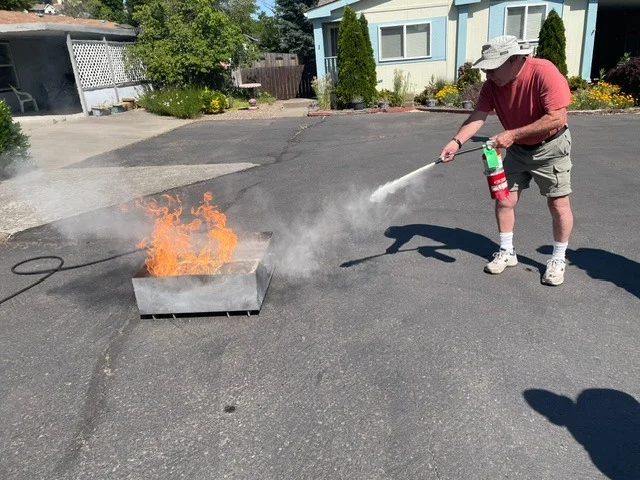
WOOSH! Steve used the PASS method and made short work of the fire. PASS is a way to remember the steps for using an extinguisher effectively:
Pull the pin.
Aim the nozzle
Squeeze the handle
Sweep the flames low.
Thanks to everyone at Fire District 5 for sharing the techniques with us.
So let’s think about what we had going on here:
First, Community involvement. Simply put, it was fun.
We also had good information being shared. For many, it was the first time they had ever held, much less used, a fire extinguisher.
It gave our residents many opportunities to ask safety questions and clarify what works well and what doesn’t.
It provided our Block Captains with opportunities to be introduced, so residents are familiar with them in an emergency.
The final benefit? Self-empowerment of our residents, and three new people volunteered to be Block Captains on their streets. A good afternoon with long-term benefits for the whole Park. That is our Association Goal.
Summer Prepping Reminders
by Professor Prepper
It’s no secret that we are in the middle of a statewide drought. Temperatures are higher than they have been, and there is no doubt they will continue to rise. The threat of fire is a constant problem. It is up to us to be prepared. There are other problems we also need to be aware of. I’ll include links throughout this article, and I suggest you check them out and contact your county office to see what services they offer in your area.
First step: Warnings.
If trouble is pulling up to your front door, you’ve waited too long to prepare. It’s a good idea to install warning apps on your phone. They have them for fire, earthquake, and other emergencies. I know in Jackson County, there is the Everbridge app to alert residents of problems. For Fires, I also downloaded and subscribed to Watch Duty. That app deals with fires and includes evacuation warnings that assign a numerical value to urgency.(Level 1, for example.)
As of today, there has been a swarm of earthquakes in the Northern California/Southern Oregon area. There have also been major earthquakes in Venezuela, causing serious damage and several fatalities. In fact, I was awakened by multiple alerts from my phone app this morning. The app, called My Shake, is available in California, Oregon, and Washington.
Having been through several major earthquakes, including the Northridge earthquake in Southern California, I have a couple of quick tips to share that are good in almost any emergency situation.
· Have a family plan for when disaster strikes. Where will you go if you have to leave the house? Where will you go if you’re staying at home?
· Have a good flashlight next to your bed. Have it fully charged if it’s rechargeable, or check the batteries frequently. If doesnot turn on, you simply have a paperweight.
· Have sturdy shoes next to your bed in case you have to get up and leave. Broken glass is very common in earthquake or disaster situations, and you do not want to be in the situation of trying to walk out barefoot.
· Have fixed positions for things (like your go bag) that you will grab if you have to leave the home in a hurry. Everyone should know the location.
· Have small children in the home, or senior citizens who are going to need a hand? Which family member is assigned to work with them? Do they know who to look for? And again, where are you going to gather should you have to leave the house? Having something on the property, something in the neighborhood, and a location in town should, in the event of a major fire, cause you to have to flee or evacuate.
I also suggest you check your specific geographic area for other alert services or sources of information that may be more appropriate for your area. The point is to begin before you need them. Each of the apps I have mentioned requires a little bit of input from you regarding your location and getting used to how to operate them in a casual setting before you need them in an emergency. This is the case with almost anything you’ll use.
The time to begin preparing for an evacuation is now. If you do not already have a bug-out bag and a plan in place, that is your first step. That way, when you get a numerical alert saying you are at level 1, which means stand by, you may have to evacuate, you can begin gathering your possessions without panic. I have been doing bug-out bag training for over a decade and have years of material you are welcome to use at absolutely no charge. I’m going to include the link to My Podcasts. No charge or donation is required to use these. I recommend that you start at episodes 1-2 and then work your way forward. Remember that over the past 10 years, the preparation timeline has changed.
When I began doing this, it was recommended that you have three days of supplies, food, water, a first aid kit, that sort of thing, and that you expect emergency help to be delayed sometimes as much as several hours. Today? The standard is now one month of self-sufficient supplies and the ability to be your own first responder for up to a week. Naturally this will change depending upon the geographic area you live, but past emergencies have shown that they are growing in scale and in the demand for resources. We are going to have to go back to being resilient as we were in our early days.
Naturally, these are just some basic ideas to get you thinking about the topic. If you have begun planning your bug out, good for you! If not, today is the day to begin. One final note. Do not go out and spend a ton of money until you know what you’re going to buy. There are hundreds of products that might be good. Look at things you’re realistically going to need. One thing I spent extra money on is working with my doctor to ensure I had a supply of medication in the event pharmacies were not available, or I was on the road. Many insurance companies will allow additional medicine to be dispensed, but they do charge for it
Restricted medications, such as painkillers, will, of course, require different regulations, but blood pressure and diabetes medications are important and should be planned for 1st. Then you can look at that water filter or cool tent you saw in the catalog.
There’s a lot to think about, and it’s a long process. The key to success is planning and communication within your immediate and extended family, even if they’re back in the Midwest. I’ll be updating this frequently, or you can simply visit the website to stay up to date.
Your safety and security begin with you. Take that first step.
Create a Directory Listing for Your Park and Leave a Rating
“This is your world, shape it or someone else will.” – Gary Lew
Have Questions? We’d love to have you on our podcast and answer your questions in the next newsletter. Send us a message using the form below and we will reach out to you.