
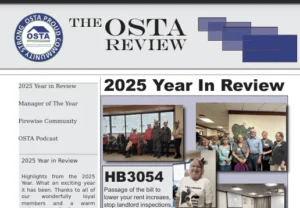
Welcome, to The OSTA Review
Read all of our newsletter articles here for the latest information on your rights as a manufactured or floating homeowner under ORS Chapter 90. View the most up-to-date legislative reports and find out what you can do to build better, more connected communities.
KATU News
Bill aims to protect tenants from rent hikes, mandates fair buyer application process
SALEM, Ore. (KATU) — House Bill 3054 would reduce maximum rent increases for renters in manufactured living communities. The bill would require the rent increases to align with the Consumer Price Index.
Manufactured homes are individually owned homes that sit in rented living spaces. Those who live in these spaces are often seniors living on a fixed income. Many tenants are growing frustrated with year-over-year hikes, with some facing eviction.
“What is truly not workable is seniors on a fixed income getting slammed with rent increases that are sometimes triple the amount of their cost of living adjustment from Social Security,” said Sen. Ben Bowman.
The bill includes protections for tenants and buyers. Landlords would be required to accept or reject tenant applications from buyers within seven days. Landlords would not be able to reject buyers based on age, size, or other factors. House Bill 3054 would also prohibit landlords from requiring home improvements or internal inspections as a condition for selling a unit in a rental facility.
Those who support the bill claim that rent increases in spaces like RV parks are unethical and driving people into homelessness. Some believe HB 3054 would protect this type of housing from excessive rent increases and help preserve the supply of affordable housing options.
“A lot of them are feeling like cash cows. They’re trapped in their homes, and they’re not able to get out of them. They can’t sell them. They can’t leave their home. They’re having to pay more and more rent, and a lot of these people are on fixed incomes,” said Rochelle Love Elder from the Oregon State Tenants Association.
Those in opposition to the bill believe that HB 3054 would pose significant challenges to housing providers and threaten the sustainability of the rental housing market. Some believe the bill would increase financial pressures on home builders, which would hurt investment in the housing market.
“This bill unfairly penalizes family-owned parks with long-term tenants,” said mobile home park owner Jennifer Backshaw. “The likely buyers will be real estate investment trusts or REITs whose profit-driven practices are the ones causing this whole mess.”
Bill Miner, a lawyer with Manufactured Housing Communities of Oregon, said the bill would depress rents far below market rates, forcing owners into three options: either run their parks to the bare minimum, sell to much larger conglomerates, or close them altogether.
“The expenses that we see, but the expenses that we see that owners have, they’re not going to be able to operate for very long,” said Miner.
Lawmakers reserved their questions for a later meeting to allow the public to testify. Another hearing on the bill will be scheduled soon.
Oregon and Washington are preparing for fights over rent increases in manufactured home parks
When Susan Zajac moved into the Royal Villas Mobile Home Park near Tigard three years ago, she thought she was making a good financial decision. She paid a mere $34,500 for her home and then rented the lot it sat on for $850 per month. Since then, her rent has steadily increased, to a current price of $1,200 per month.
Unlike many of her neighbors in the 55-and-older park, Zajac still works, but she says the increases from the park’s owner, Cal-Am Properties, are especially hard on her neighbors, many of whom are seniors on fixed incomes.
“It’s not the way it should be,” Zajac said.
She’s one of a growing number of tenants at manufactured home parks calling foul on park owners for what they say are exorbitant rent increases and unfair fees that are threatening to push tenants out of their homes altogether.
“It’s one of those situations where it seems like me and others buy in and kind of expect normal rent increases but not the exorbitant increases that have been happening,” she said.
Zajac was recently in Salem to support legislation aimed at protecting tenants like herself. The proposal, House Bill 3054, would cap rent increases for tenants in manufactured home parks and marinas at average cost increases as measured by the Consumer Price Index. Currently, rent increases cannot exceed 10% per year.
Other protections would cap the rent of someone who bought an existing mobile home in a park at 10% above what the seller was paying. Landlords would be restricted from requiring tenants to make aesthetic changes to their homes or to require home inspections when their manufactured home is being sold.
A similar fight is brewing in Olympia, where lawmakers recently introduced House Bill 1217. Termed a rent stabilization bill, the proposal would cap rent increases for all types of housing at 7% per year to provide “Washington renters with predictability, transparency, and the same protections afforded to other consumers.” It, too, specifically mentions manufactured homes.
The bills are two examples of ways to address the uniquely vulnerable position of residents in manufactured home parks. Unlike in apartments, people who own such homes but rent the land they’re on have less ability to leave if rental costs increase too quickly. Many are senior citizens living on fixed incomes, and steady rent increases cut against the value of their homes by making them less attractive if they wanted to sell.
Mobile home parks have also become a de facto source of low-income housing in places like Oregon, where housing production goals continue to lag and where building more homes is a key piece in addressing homelessness.
According to Clark County Assessor Peter Van Nortwick, manufactured home park residents, who are simultaneously renters and owners, are especially vulnerable to rising costs.
“They’re kind of getting hit double,” he said. “They will see increases in rents but they will also see decreases in the value of their manufactured home that’s sitting in the park.”
Arguments that rental rates should be left to the free market break down when tenants don’t have a choice of where to move, said Sen. Jeff Golden, D-Ashland, during recent testimony in support of HB 3054.
“As a practical matter, the tenants in these parks don’t have that choice,” Golden said. “The economics of moving a manufactured home to a theoretical competitor’s park keep tenants captive where they are as an economic matter.”
Both proposals in Oregon and Washington have been met with strong opposition from park owners, who say the legislation amounts to rent control and that it will have the opposite of its intended effect.
They argue that caps on rent increases will depress prices below market rates and force owners to run parks at the bare minimum standards so they fall into disrepair. During a committee hearing in Salem, opponents said the Oregon proposal would lead to more locally-owned parks being bought up by national conglomerates.
Jennifer Bagshaw owns a 180-unit manufactured home park in Medford. During testimony, she said the proposed Oregon legislation would have unintended consequences.
“My average increase per year for expenses is roughly 8%, and that is climbing steadily. As a small landlord, I rely on the flexibility to adjust rent for new tenants to cover these rising costs,” Bagshaw said. “Without the ability to adjust rents when homes turn over, these rising costs will become unmanageable, forcing small landlords like me to sell. The likely buyers will be real estate investment trusts, whose profit-driven practices are the ones causing this whole mess.”
The Washington and Oregon bills are in their early stages and have not yet been debated by the full legislatures, but supporters are hoping to keep the pressure on lawmakers. Washington’s chapter of the Association of Manufactured Home Owners is planning to rally with supporters for HB 1217 in Olympia on March 14.
Zajac, the renter in Portland’s southwest suburbs, said a recent town hall event at Royal Villas to discuss HB 3054 attracted 200 people to their park’s clubhouse, where they told visiting lawmakers their stories.
“Homelessness is a crisis that everyone doesn’t like. Everyone across the board,” Zajac said. “And it’s like, how do we solve it? Keep people in their homes.”
Correction: A previous version of this story misstated the amount that rent could be increased at manufactured home parks under HB 3054. OPB regrets the error.
Create a Directory Listing for Your Park and Leave a Rating
“This is your world, shape it or someone else will.” – Gary Lew
Have Questions? We’d love to have you on our podcast and answer your questions in the next newsletter. Send us a message using the form below and we will reach out to you.